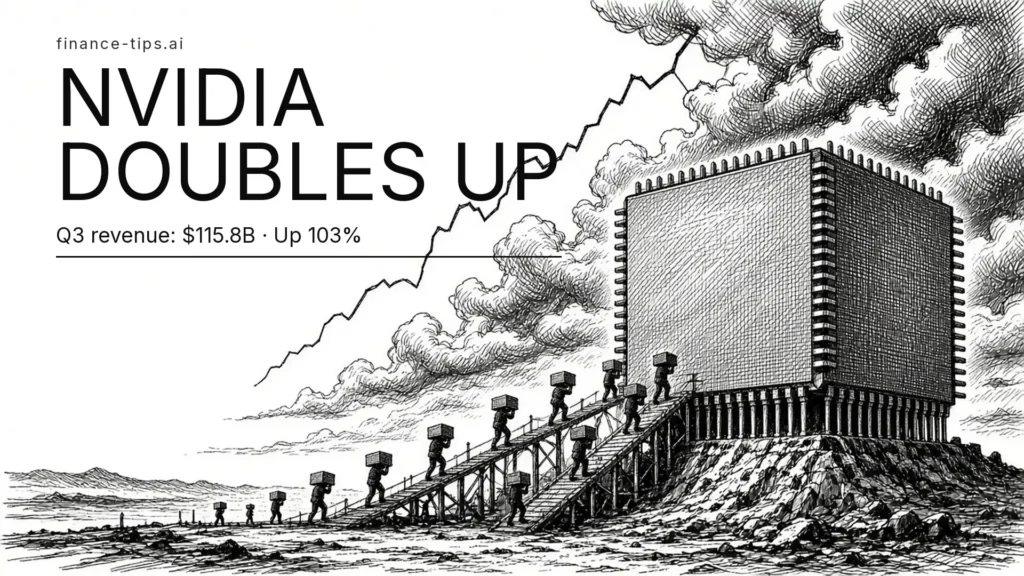
Nvidia just posted the kind of quarter most companies only see in their dreams: sales more than doubled. The catch? It landed in the middle of a market tantrum and the company’s first week without its co-founder as CEO.
The Numbers
For the quarter ended October 25, Nvidia reported, according to its earnings release:
- Revenue: $115.8 billion, up 103% from a year ago and up 20% from last quarter
- Data center: $107.6 billion, up 110%. That’s roughly 93 cents of every revenue dollar coming from AI and data center chips.
- Gross margin: 74.8% (GAAP)
- Earnings: $2.70 per share (GAAP), or $2.68 adjusted
Wall Street was expecting about $109.1 billion in revenue and $2.48 in adjusted earnings per share, per LSEG estimates cited by CNBC. So, a clean beat.
And It’s Not Slowing Down (Yet)
Nvidia guided to about $130 billion in revenue this quarter, plus or minus 3%. Fine print: this quarter has an extra week, and Nvidia isn’t counting any data center compute sales to China. Analysts had penciled in about $125.1 billion, per LSEG.
One thing to watch: Nvidia expects gross margins to dip to 71% to 72%. Interim CEO Colette Kress said on the call that the dip comes from honoring pricing on existing orders and that she expects margins to bottom this quarter, MarketWatch reported.
So Why the Shrug?
The backdrop is rough. On Tuesday, the Dow fell more than 1,000 points at its low before closing down 849, and the S&P 500 closed below its 200-day moving average for the first time since April, according to CNBC. Translation: the market’s long-term trend line just got crossed, and chart watchers hate that.
Nvidia’s stock rose as much as 3.8% after hours Tuesday. By about 9:40 a.m. PT Wednesday, the pop was gone, with shares down about 2% near $152. MarketWatch noted the stock had already fallen more than 36% from its October high.
Part of the mood: this was Nvidia’s first report since Jensen Huang resigned as CEO on November 12. Kress is filling in while the board searches for a permanent CEO, and new board chair Harvey Jones said on the call that the board does not intend to bring Huang back, CNBC reported.
What It Means for You
Own an S&P 500 index fund? You own a slice of Nvidia, one of the biggest companies in the index. When AI stocks swing, your “boring” fund swings too.
The big question: Can AI spending keep growing this fast? Nvidia’s $130 billion forecast says yes, for now. The market is saying “prove it.”
The Market Angle
Analysis assisted by Artificial Intelligence
This section explains some connections for educational purposes. It does not recommend any security, and none of it is a prediction.
Chip ETFs
The VanEck Semiconductor ETF (SMH) and the iShares Semiconductor ETF (SOXX) both hold Nvidia alongside other chipmakers and equipment makers, but they weight their holdings differently, so the same Nvidia move can hit each fund by a different amount. Holdings change, so the fund providers’ websites are the place to check current weights.
The Supply Chain
Nvidia designs its chips but relies on partners to build them. Taiwan Semiconductor (TSM) manufactures many of its processors, and memory makers such as Micron (MU), SK Hynix and Samsung supply the high-bandwidth memory that AI systems use. In this release, Nvidia also named packaging and component partners including Amkor and IBIDEN as part of plans to scale manufacturing. Demand forecasts like Nvidia’s can ripple through all of these companies.
Follow the Customers
Nvidia’s revenue depends heavily on spending by cloud providers and AI companies. The release names Microsoft Azure, Google Cloud, Oracle Cloud Infrastructure, CoreWeave and Nebius among partners running its newest Vera Rubin systems. Changes in those companies’ capital spending plans are one of the most closely watched signals for chip demand. Neocloud stocks, which often rely on borrowed money to build data centers, have been especially volatile: CoreWeave, Nebius and Iren each rose more than 9% after hours Tuesday, per MarketWatch, then CoreWeave fell more than 6% Wednesday, per CNBC.
Index Concentration
A handful of AI-linked giants make up a large share of the S&P 500’s value. That means broad index funds can be more sensitive to AI sentiment than their “diversified” label suggests.
The Risks
Guidance is a forecast, not a promise. Lower margins next quarter, export rules affecting China, competition from customers designing their own chips, the CEO search and any slowdown in AI spending could all affect Nvidia and related stocks. Chip stocks have historically been volatile.
Sources: Nvidia, CNBC, MarketWatch, fund provider websites for current holdings.