Anthropic, the maker of the Claude AI models, is set to go public this week in what CNBC calls a “historic” offering. According to Anthropic’s preliminary prospectus and news reports, it plans to sell 825 million shares at an estimated $70 to $78 each, with an unusually large slice reserved for individual investors. Here is what has been filed and reported, how retail investors can and cannot get in, and the practical points to know. This is a securities offering in its pre-pricing period, so this post sticks to facts from the filing and from reporting. It does not predict how the shares will trade.
The Offering at a Glance
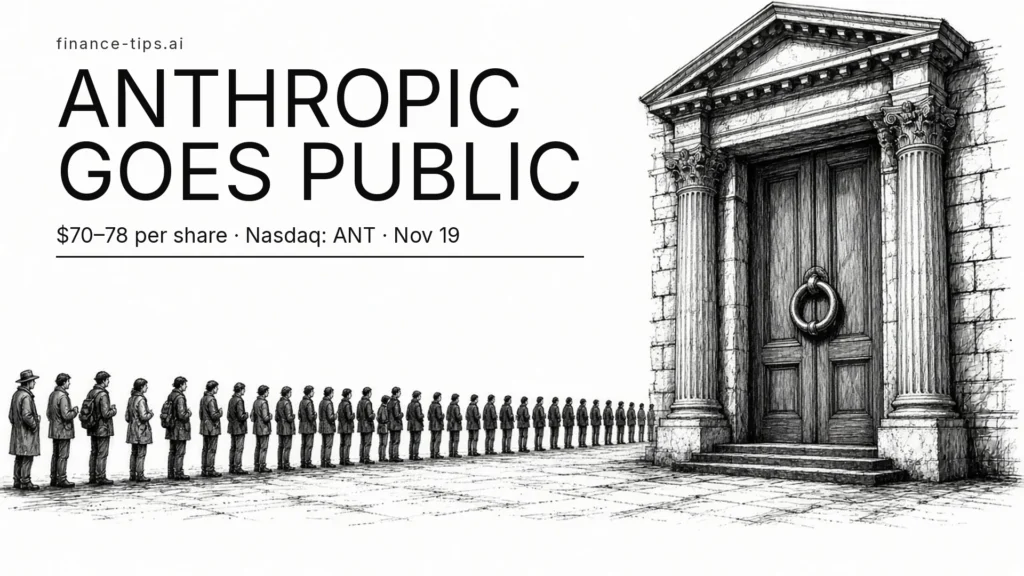
- Dates: CNBC reports the IPO is expected to price the evening of Wednesday, November 18, with shares scheduled to begin trading Thursday, November 19. Nasdaq’s trader notice lists a November 19 listing date for the Class A common stock. Pricing and trading dates can change.
- Ticker and exchange: “ANT” on the Nasdaq Global Select Market, according to the preliminary prospectus (dated November 10 and “subject to completion”).
- Size and price: 825,000,000 Class A shares at an estimated $70.00 to $78.00 per share. Of those, 801,351,354 shares are being sold by the company and 23,648,646 by existing stockholders. The underwriters also have an option to buy up to 123,750,000 more shares from the company.
- Money raised and valuation: CNBC says that at the current range the offering would bring in more than $64 billion and put the company’s valuation at $1.405 trillion. Reuters has described the valuation as up to $1.4 trillion. The 825 million shares at the top of the range works out to about $64.4 billion. The final price can differ from the range, so check the final prospectus.
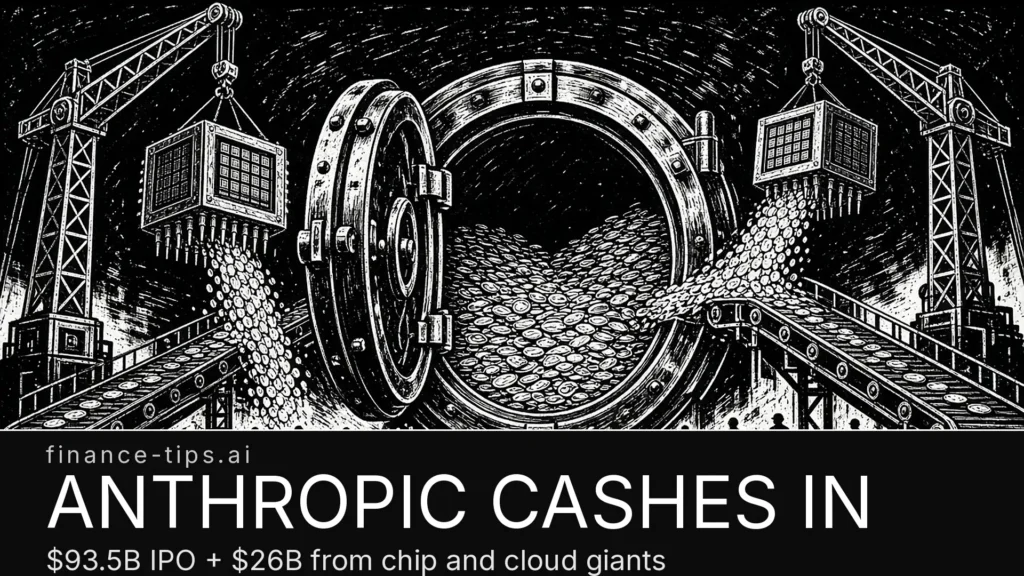
- Separate private placement: The prospectus also describes a concurrent $26.0 billion private sale of non-voting Class N shares, at the IPO price, to Google, NVIDIA, AMD, Broadcom, Micron, Microsoft and TSMC. These shares are not part of the public offering.
- Lead underwriters: Goldman Sachs and Morgan Stanley are the representatives of the underwriters. The syndicate also includes J.P. Morgan, Citigroup, BofA Securities, Deutsche Bank, BMO Capital Markets, BNP Paribas, BTIG, Cantor, Barclays, Wells Fargo and RBC Capital Markets.
- Retail allocation: Anthropic says it currently expects allocations to retail investors in the U.S. and other countries to represent up to 20% of the Class A shares offered, though “final amounts will be based on actual demand.” CNBC notes the typical retail share of an IPO is 5% to 10%.
How Retail Investors Can (and Can’t) Get Shares
The prospectus says a portion of the shares will, at Anthropic’s request, be offered through selling-group brokerages: Charles Schwab, Fidelity, Robinhood, Trade-PMR, SoFi and E*TRADE from Morgan Stanley, including on their online platforms. Purchases through these platforms are made at the IPO price and are “subject to the terms, conditions, and requirements set by each respective entity.” The brokerages are not affiliated with Anthropic. Some key points:
- Eligibility varies by broker. InvestingLive reported that Fidelity requires at least $25,000 in assets with the firm and Schwab $50,000, and that brokers may divide shares pro rata, in fixed amounts or by lottery. Rules change, so check directly with your broker.
- A request is not a guarantee. According to InvestingLive, Anthropic’s own IPO page says a request does not guarantee a purchase, and investors should be ready to buy every share they ask for. Requests are not confirmed until allocations are made.
- Demand is reported to be heavy. Reuters reported on November 13, citing people familiar, that the order book was six times oversubscribed by the end of Thursday, and Bloomberg reported on Sunday that orders were close to seven times the shares on offer, according to The Next Web. Reuters, citing Bloomberg, also reported that bankers told investors Anthropic would prioritize existing backers, leaving some buyers with smaller allocations than expected. These figures come from unnamed sources and could change.
- Retail platforms may penalize quick selling. InvestingLive reported that Fidelity warns selling IPO shares within 15 days can limit access to future deals. Check your broker’s policy.
Day One: Orders, Volatility and Lockups
- The IPO price and the opening price are different things. Investors who receive an allocation pay the IPO price set on pricing night. Everyone else buys on the open market once trading begins, at whatever price the market sets.
- Market vs. limit orders (general information): A market order fills at the best available price, which on a first trading day can be far from where a stock was a moment earlier. A limit order sets the highest price a buyer is willing to pay, but it may not fill at all. First-day trading in new listings can be volatile in either direction.
- Lockups: According to the prospectus, directors, officers and holders of substantially all of the company’s stock have agreed to restrictions on selling for up to 180 days, or up to 365 days for the co-founders and certain large holders, subject to exceptions and early-release provisions. The filing also says that up to 316 million Class A shares may become eligible for sale starting on the first trading day, and that the Class N shares sold in the private placement are not subject to lockups. Share supply from these sources can affect trading.
- Ownership structure: Anthropic is a public benefit corporation. Under the filing, a special Class F share held by an entity formed by the co-founders carries 50.1% of the total voting power, and the company says it is a “controlled company” under Nasdaq rules. Class A shares carry one vote each.
What the Filing Says About the Business
These figures come from the preliminary prospectus and may be updated in the final version:
- Revenue: $41 million in 2023, $386 million in 2024 and $4.6 billion in 2025. For the nine months ended September 30, 2026, revenue was $33.2 billion, up from $2.5 billion a year earlier. The filing says it does not expect revenue to keep growing at comparable rates.
- Run-rate revenue: About $81 billion as of October 31, 2026, per the company’s own non-GAAP metric, which annualizes recent usage and is not a forecast.
- Losses: The filing reports a net loss of $104.0 billion for the nine months ended September 30, 2026, and $42.0 billion for 2025. It says these included large changes in the fair value of convertible notes and similar instruments, $94.3 billion in the 2026 period, mainly from a higher company valuation. The operating loss for the nine months was $1.3 billion, down from $5.2 billion a year earlier.
Risks Anthropic Itself Highlights
- Reliance on cloud partners: The company says it relies on Amazon, Google and Microsoft for compute, and that each also offers competing AI services.
- Competition: The filing names Alphabet and OpenAI among its primary competitors.
- Government dispute: The filing describes a legal dispute with the U.S. Department of War over a “supply-chain risk” designation. It says a federal district court largely ruled in Anthropic’s favor in August, while a split D.C. Circuit panel on September 25 denied its petition on a separate designation and Anthropic has asked for rehearing. The company says it cannot predict the outcome.
- Heavy spending: It describes its business as highly capital intensive, with a history of net losses.
Reuters reported that some investors remain cautious about the high valuation, citing limited roadshow disclosure and questions over how long Anthropic can keep its lead as rivals catch up. Anthropic declined to comment on those remarks.
Practical Takeaways (General Information, Not Personal Advice)
- Read the prospectus first. The risk factors and the section on shares eligible for future sale are where the details are. A final prospectus is expected after pricing.
- Know your broker’s rules. Account minimums, how allocations are split, whether you can cancel a request, and any penalties for selling quickly all differ by firm.
- Allocation, if any, may be small. With reported demand well above the number of shares, individuals may receive less than they request or nothing.
- Consider concentration. Many investors already have AI-related exposure through broad index funds. Any single new holding is one more factor in an overall portfolio.
- Be wary of hype and impersonators. New listings attract scam offers and “pre-IPO” products. Before trading begins, Anthropic’s shares are available only through the underwriters and selling-group brokerages named in the prospectus.
Sources: CNBC IPO guide, CNBC on the price range, Anthropic preliminary prospectus (as hosted by J.P. Morgan), Nasdaq Trader notice, Reuters via Investing.com, Reuters on the Bloomberg report, The Next Web, InvestingLive. Information as of the morning of November 16, 2026; terms and timing may change.
Follow the Money
Analysis assisted by Artificial Intelligence
A deal this large touches funds, suppliers, rivals and the wider IPO market. This section explains some of those connections for educational purposes. It does not recommend any security, does not suggest taking part in the offering, and none of these links is a prediction.
Index Funds and ETFs
Large IPOs can now enter major indexes quickly. Reuters reported that Anthropic is expected to be added to at least six big indexes, including the Nasdaq-100, within 5 to 15 days of listing. Vanguard says fast-track policies allow eligible stocks to join within about five to 15 trading days and that Vanguard funds tracking the Morningstar US indexes, such as VTI and VUG, are expected to add it after the close of the fifth trading day. Its estimate of the initial weight is small, partly because only an estimated 5% to 7% of shares may be available to public investors. Under Nasdaq’s fast-entry rule, as described by Yahoo Finance, a new listing that ranks among the 40 largest Nasdaq-100 companies by market value can join after 15 trading days, which would affect funds that track that index, such as the Invesco QQQ Trust (QQQ). The S&P 500 is different: Vanguard says it requires at least 12 months of trading history and positive earnings, so funds tracking it, such as VOO, would not add the stock at IPO. London-based analytics firm Intropic estimates passive demand could equal about 28% of the shares offered, or about $19 billion, according to Reuters. Estimates like these are projections and index providers set their own timing.
Broad technology and AI-themed funds, such as the Technology Select Sector SPDR Fund (XLK) and semiconductor funds such as SMH and SOXX, hold some of the companies connected to Anthropic described below. Holdings and weights change, so the fund providers’ websites are the place to check them.
The Private Placement and Chip Suppliers
The prospectus lists Google, NVIDIA, AMD, Broadcom, Micron, Microsoft and TSMC as buyers in the $26.0 billion private placement. At the $74 midpoint of the range, the filing says Google and NVIDIA would each buy about $10.0 billion of Class N shares, AMD $2.5 billion, Broadcom, Micron and Microsoft $1.0 billion each and TSMC $500 million. It says the Google purchase would fund a portion of previously committed investment obligations. These companies are also suppliers or partners of Anthropic, so Anthropic’s spending, and its own funding, may flow back to them through compute and chip purchases. The filing also says Anthropic uses chips from Amazon (Trainium), Google (TPUs), NVIDIA and AMD.
Cloud Partners and Competitors
The filing says Anthropic relies on Amazon Web Services, Google Cloud and Microsoft Azure, and that Amazon, Google and Microsoft also develop competing AI models. Amazon holds convertible notes that convert to non-voting Class N stock up to an ownership cap, according to the filing. Alphabet (GOOGL) is named as a competitor and is also a placement buyer. OpenAI, which is privately held, is the other primary competitor named. Reuters reported that investors are weighing whether Anthropic can keep its lead as Google and other rivals advance, and that the valuation models use SpaceX and CrowdStrike among their comparison companies.
What It Could Signal for the AI Trade and the IPO Pipeline
CNBC compared the demand with SpaceX’s record $86 billion IPO in June, and Bloomberg-sourced reports say Anthropic and its backers could raise up to about $90.4 billion counting the private placement. Commentators often treat a very large, well-subscribed deal as a read on appetite for AI and for other big private companies thinking of listing, while a weak debut can have the opposite effect. Heavy demand before pricing does not determine how shares trade afterwards, and large IPOs have had mixed results over time.
The Risks
The offering terms, pricing and timing could change, and the preliminary prospectus is not final. Valuation is based on forecasts, and Reuters reported that projections vary widely among banks and investors. Share supply from lockup releases, a high valuation relative to current revenue, the cloud-partner dependence and the legal dispute described above are among the risks the company or the reporting highlights. Funds with exposure to the stock after index inclusion also take on its volatility.
What to Watch
- November 18 (evening): expected pricing and the final prospectus.
- November 19: expected first day of trading on Nasdaq.
- Index announcements: fast-entry additions to the Nasdaq-100 and other indexes in the following days to weeks.
- Lockup dates: early-release provisions and the 180-day and 365-day expirations described in the filing.
- The first earnings report as a public company and any updates on the government litigation.
Sources: Anthropic preliminary prospectus, Vanguard, Reuters via Investing.com, Yahoo Finance, CNBC, fund provider websites for current holdings.
Disclaimer: This post is for informational and educational purposes only and is not investment advice. finance-tips.ai and its authors may hold positions in securities mentioned. Do your own research or consult a licensed professional.